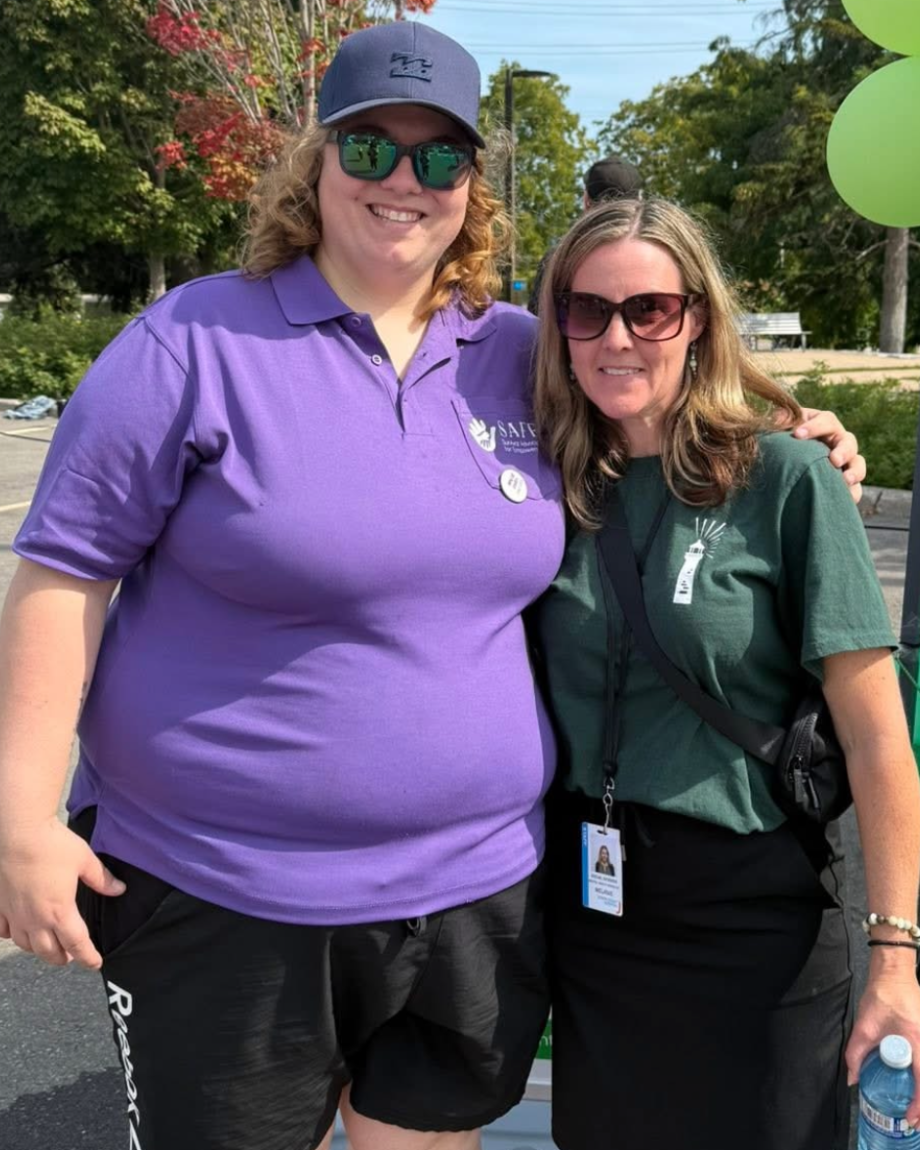
Throughout her recovery journey, Ashley found support not only through treatment but through the people who refused to give up on her. She credits the teamwork within the Emergency Department and Mental Health programs for helping patients feel safe and cared for during some of the most vulnerable moments of their lives.
“When someone comes in struggling with mental health or addictions, they get you somewhere safe quickly,” Ashley explains. “They don’t leave you sitting alone in a waiting room. They want you to feel comfortable and supported.”
One moment in particular changed the course of her life.
A doctor at Joseph Brant Hospital spoke honestly with Ashley about the severity of her drinking and told her that if she continued down the same path, she likely would not survive another year.
“That scared me straight,” Ashley says. “I always thought, ‘That can’t happen to me. I’m invincible.’ But hearing that made me realize I needed help.”
That realization led her more deeply into Dialectical Behaviour Therapy (DBT), where Ashley says she began learning practical skills to manage both her mental health and addiction.
“Cognitive behavioural therapy focuses on thoughts, but DBT teaches you the actual skills and behaviours,” she explains. “At first, I didn’t think these skills could possibly change my life. But once I started putting in the work — doing the homework, asking questions, participating — everything started to change.”
Today, Ashley not only continues using those skills in her own recovery, but she now helps others through the same program that helped save her life. Since 2025, Ashley has volunteered as a co-facilitator in the DBT program, supporting patients navigating concurrent mental health and addiction challenges.
She is also actively involved with Walk to the Lighthouse, a campaign that holds deep personal meaning for her and her family.
“Walk to the Lighthouse hits so close to home,” she says. “Mental health affected my mom too, and the hospital always treated her with compassion.”
Ashley is hopeful about the redevelopment and expansion of the Mental Health & Addictions Unit. She believes that adding private rooms, improving spaces, and expanding services will make a significant difference for patients and families.
“The expansion is going to help so many people,” she says. “Having privacy, having spaces that feel less clinical — those things matter.”
Her message to anyone struggling with mental health or addiction is simple.
“If someone is looking for help, they will find it at Joseph Brant Hospital. There’s no judgment here. The staff truly care. You do have to put in the work — but help is here, and recovery is possible.”
And through everything she has endured, one belief continues to guide her forward:
“We can only appreciate the miracle of a sunrise if we have waited in the darkness.”
If you would like to support Ashley and her Walk to the Lighthouse this year, you can make a donation to her personal fundraising page here.